Unpacking the Anxiety
There are a few things I commonly hear from the naysayers of the "AI will take our jobs" narrative:
- When computers were invented, people simply learnt to use them. It did not result in large-scale unemployment.
- There's no way AI is taking our jobs. It can't even do XXX task reliably right now.
- Organizations will still need people to be responsible for something and make decisions.
Let's go through them 1-by-1.
"1. When computers were invented, people simply learnt to use them. It did not result in large-scale unemployment"
There is something fundamentally different between the impact of computers on jobs and the impact of AI on jobs. To unpack that, we need to first ask ourselves this question: What is the single biggest commodity that human beings offer to the capitalistic system?
Intelligence.
A capitalistic society, i.e. corporations as a single collective, demands and pays for human labour for the simple reason that human beings are intelligent enough to:
- Decide (and be responsible for) certain tasks
- Orchestrate certain tasks
- Execute certain tasks
If AI ever reaches a point where it can do either (1), (2), (3), or a combination of them at a faster, cheaper and better (in accuracy) rate, then for certain subset of tasks, corporations now have a "next better alternative" to intelligence.
The "when computers were invented" argument do not work for me because when computers were invented, they were algorithmic. They were not smart, and hence they cannot be a drop-in replacement for intelligence, the most valuable commodity humans offer to corporations. They merely automated virtual algorithmic tasks that a certain subset of the human race used to spend their day-to-day working on. That subset might have gradually gotten automated away, but because humans and only humans were capable of intelligence, we simply upskilled and re-educated those workers to do higher-order tasks where they can better leverage on their intelligence to achieve more productivity.
Essentially, what people fear is a hypothetical future where AI gets so good that it becomes capable of being better at intelligence than human labour (better, faster, cheaper, more efficient), in which case there's just no way for the cost of human labour at the same scale of billions to be as appealing to corporates anymore.
"2. Okay, but, there's no way AI is taking our jobs. It can't even do XXX task reliably right now"
- As it stands right now, AI systems are already capable of automating jobs. Not entire job functions and industries, really, but as I see it, it's a lot more of a "Previously it takes 10 people to do this task. Now it takes 3 and some tokens.".
- Even if we assumed (1) is not true, simply looking at the sheer trajectory of this advancement is telling enough. We can debate all day about the scaling laws of LLM, but the gradient of AI advancement today is undeniably high, higher than we'd expect 3 years ago. The amount of fundings and bright minds poured into this is unprecedented. It's hard to see a world, based on the rate of change of gradient (d^2y/dx^2), where the growth of AI and LLMs will reach a plateau anytime soon. Extrapolating from the trends, models will keep getting cheaper, smarter, faster and more efficient on the compute.
- And perhaps the most important point of this all, is that anyone who claims AI will not in the near term be more intelligent than human beings with 100% certainty is absolutely LARPing. In fact, anyone who makes any claims about where AI will be in the future with 100% certainty is also LARPing. No one knows where this is going. No one knows how smart the models will get. Anthropic could literally announce tomorrow that AGI has been achieved with a 100B model, or it could happen only 50 years later, or it could never happen. What makes people so sure?
The point is, based on the trajectory from 2022 till now, there is a Y% chance that if this trajectory holds up, AI will cross the threshold of human intelligence in 5 years. The point of contention here is what the value of Y is. Some people think Y=10. In my head, Y=50, but maybe that's because I'm working in the AI field and seeing first-hand what it's capable of. Some people think Y=90. Regardless, years ago, most people thought Y=0, and the fact that Y has gradually increased over the years is the scary part.
In fact, Y>0 is exactly what is causing large-scale Anxiety. The fact that there's a more-than-zero percent chance of large-scale unemployments in 5 years, and many would lose their livelihoods to no fault of their own, is exactly what causes anxiety. Even people who thinks Y=0.1, which is extremely unlikely, will worry and feel the need to hedge for the future where the 0.1% chance happens. That is anxiety. It need not be rationale. It need not be likely. But what seems obvious is that the fear of Y% occurring, Y>0, is causing massive anxieties across the world right now, and the anxiety is only growing over time.
"3. Organizations will still need people to be responsible for something and make decisions"
Yes. That is true. AI cannot be responsible for mistakes made, bad decisions, negligence etc (hint: huggingface incident). Organizations will still hire people to make decisions, orchestrate AIs and ultimately be responsible for the outputs.
Unfortunately, most jobs at the lower levels of organizational hierarchy are jobs that are usually more execution-oriented. As we move down most organizational hierarchies, people's work become more execution-based and less orchestration/decision-making. Even if there are decision making done at this level, they are typically lower-order, microscopical decisions that AI could do better than humans in.
For example, within the tech industry itself, junior engineers used to be given well-defined PRDs/features as full, month-long projects. Now, with a very well-defined PRD and scope, the task could just get one-shotted by Claude Code in minutes, and what's left is a testing/verification which will take a way shorter time.
We are already seeing this trend pop up in other white collar industries, and this will get more and more rampant once these industries figure out verifiability, and what are the only points in a given task where they need humans in the loop.
In short, as the needs for a human to do the execution-oriented tasks continue decreasing, this is what is going to happen:
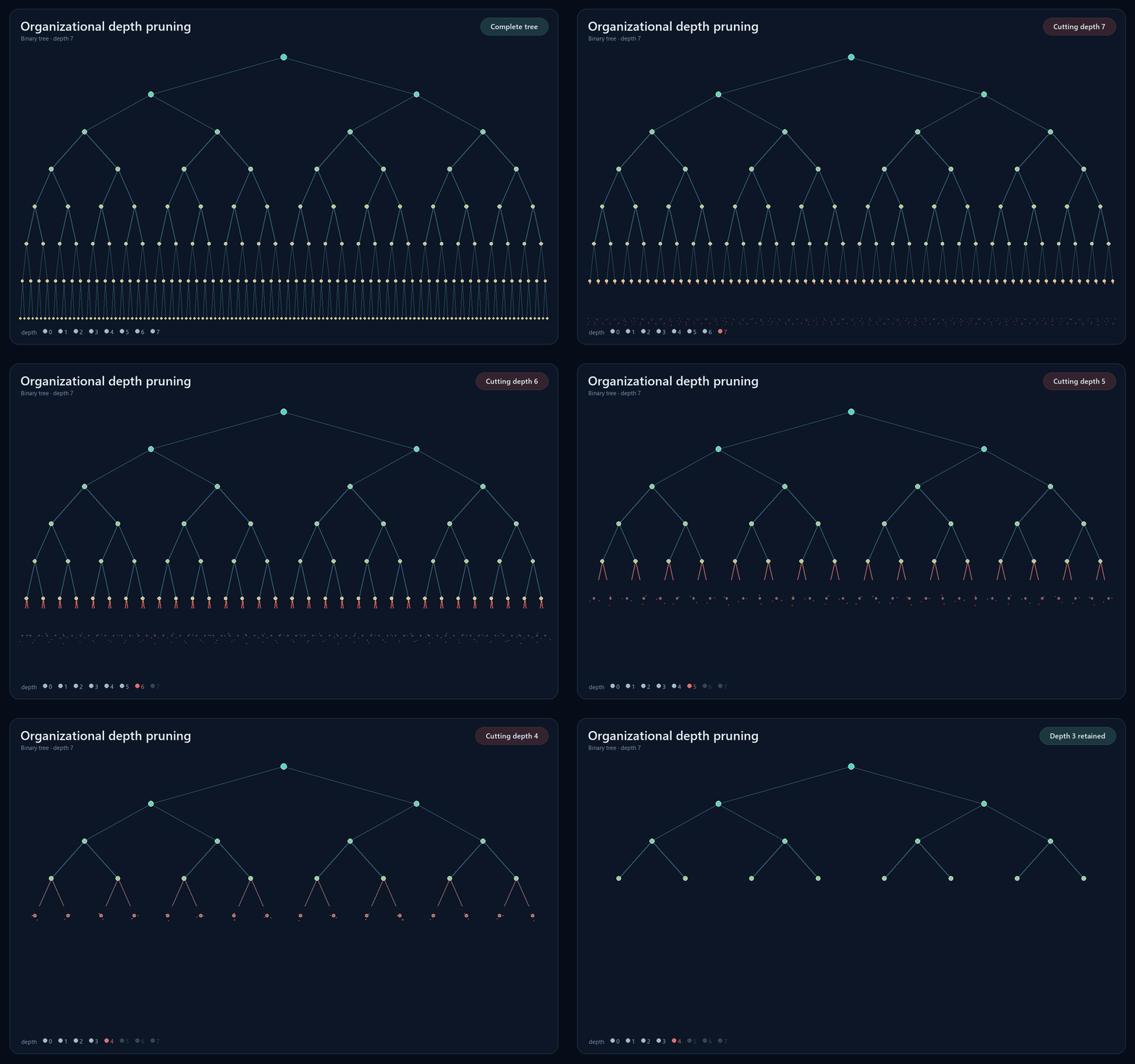
We are already seeing this happen in real-time. This is the hardest time in the past two decades for fresh graduates or junior engineers to find a job and insert themselves as a leaf node at the bottom of organizational structures. Large-scale layoffs are happening in the tech industry and beyond. Companies are becoming increasely vocal about flattening hierarchies, concentrating decision-making upwards, and forcing AI usage onto everyone in hopes to massively increase productivity.
This all leads to people feeling like they need to move up the organizational hierarchy fast enough such that their work changes to more orchestrating and decision-making, and they will get to escape this pruning. The race to promotion becomes more important than ever, and people are fighting tooth and nail for it. Long hours. Endless politics. Entire organizations, teams and individuals competing intensely to stay relevant. This is what we are seeing unfold across the world right now.
And we wonder why people are feeling anxious?